
Hydro Jetting in Metro Detroit for Drains That Keep Clogging
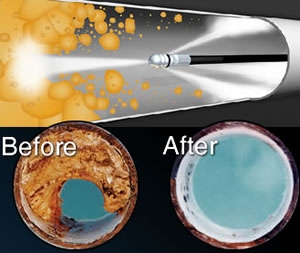
Hydro jetting, also called water jetting, cleans the inside of a drain or sewer line with high pressure water instead of punching a hole through the blockage. It removes the grease, sludge, scale, and root hair that coat the pipe wall and cause the same clog to come back. Drain Detectives has been jetting residential and commercial lines from our Fraser, Michigan shop across Macomb, Oakland, Wayne, and southern St. Clair County, for homes, restaurants, and property managers alike.
- Camera inspection first
- Grease and kitchen lines
- Restaurants & multi-unit
- No caustic chemicals
- 24/7 emergency response
Line backing up right now? Stop running water, including the washing machine and dishwasher. Every gallon you send down has nowhere to go.
(586) 296-0036 (248) 645-2448Cabling, Jetting, or Repair: What Each One Actually Does
These three get used interchangeably in quotes you receive, and they are not the same service or the same result. Here is the honest comparison.
| Cabling / snaking | Hydro jetting | Repair or replacement | |
|---|---|---|---|
| What it does | Bores an opening through the obstruction so water moves again | Scours the full pipe diameter back toward original capacity | Replaces the failed section of pipe |
| Best for | A single clogged fixture, a sudden blockage, fast relief | Grease, sludge, scale, soft root mass, repeat clogs, long main runs | Collapsed, offset, bellied, or badly deteriorated pipe |
| Leaves behind | Most of the buildup still coating the pipe wall | Clean pipe wall, debris flushed downstream | New pipe |
| Typical lifespan | Shortest. Clogs often return as buildup narrows the opening again | Longer, and it can be scheduled on a maintenance interval | Longest |
| Where to read more | Drain cleaning | This page | Sewer repair |
When Jetting Is the Right Call, and When It Is Not
Hydro jetting is not the answer to every drain problem, and a company that tells you otherwise is selling rather than diagnosing. This is how we decide.
Jetting is usually the right move
- The line clears after snaking, then clogs again within weeks or months
- Kitchen and grease lines in homes, restaurants, and multi-unit buildings
- Multiple fixtures draining slowly, pointing at a narrowed main rather than one trap
- Long main line or lateral runs where debris settles out
- Soft root hair intrusion at pipe joints, with a cutting nozzle
- Scheduled preventive maintenance on a line with a known history
We inspect before jetting, or recommend something else
- Orangeburg pipe. If the home was built roughly between the late 1940s and early 1970s, the lateral may be this bituminized fiber material, which deforms and fails rather than cleans
- Severely corroded cast iron where the pipe wall is already compromised
- A line the camera shows as collapsed, offset, or bellied. Jetting a broken pipe cleans a broken pipe
- Heavy woody root masses, which usually need mechanical cutting or repair, not water alone
- Any line where we cannot confirm material or condition. That is what the camera is for
What Happens During a Hydro Jetting Service
A jetter feeds a high pressure hose into the line through a cleanout. The nozzle sprays forward to cut and rearward to propel itself up the pipe, so it climbs the line while flushing everything it loosens back toward you and out.
-
Locate access and inspect
We find the right cleanout and, for recurring or main line issues, run a camera first. Knowing the pipe material and condition determines the pressure and nozzle, and sometimes determines that we should not jet at all.
-
Match nozzle and pressure to the line
A penetrating nozzle opens a hard blockage. A flushing nozzle moves sludge and debris. A rotating nozzle scours grease and scale off the wall. Flow rate matters as much as pressure, because pressure cuts but flow is what actually carries material out of the pipe.
-
Clean the full run, then verify
We work the line to its full length rather than stopping at the blockage, then confirm flow. On chronic lines we will tell you what the camera showed and whether this is a maintenance situation or a repair situation.
Why we do not use caustic drain chemicals
Store-bought and industrial drain openers generate heat, sit in standing water, and attack the pipe as readily as the clog, which is a genuine problem in older cast iron. They also make the line hazardous for whoever opens it next. Jetting uses water and mechanical force, nothing else.
Grease Line Jetting for Restaurants and Multi-Unit Properties
Commercial kitchens generate the single most predictable drain failure there is. Fats, oils, and grease go down warm and liquid, cool in the line, and harden onto the pipe wall a little more with every service.
-
Restaurants and commercial kitchens
Kitchen branch lines, grease interceptor discharge lines, and mains. Scheduled jetting is cheaper than the alternative, which is a backup during dinner service and a closed dining room.
-
Apartments and multi-unit buildings
Shared stacks and mains carry the habits of every unit in the building. Jetting the common lines on an interval is the standard preventive approach for property managers.
-
Retail, offices, and facilities
Break room lines, floor drains, and long horizontal runs that collect debris because they were never designed for the volume they now carry.
-
Scheduled maintenance programs
If your line has a history, the right interval is the one that gets ahead of it. We set that based on what the line actually does, not a generic calendar.
What We Find Inside Metro Detroit Sewer Lines
The housing stock here shapes what is in the pipe. Three things come up constantly across Macomb and Oakland County.
- Scaled cast iron. Pre-1960 homes across Detroit, Ferndale, Royal Oak, and the older parts of Warren commonly have cast iron drain stacks. Decades of scale build inward until the effective diameter is a fraction of what was installed. Jetting with a rotating nozzle takes that back, though heavily scaled cast iron sometimes needs mechanical descaling first.
- Clay tile laterals with root intrusion. Older laterals were laid in short clay sections with joints at every seam. Mature street trees find the joints and re-enter the same spot every season. Jetting clears the seasonal growth. The camera tells you whether the joint itself has failed.
- Grease from decades of ordinary use. Not just restaurants. A family kitchen puts enough fats down the line over twenty years to meaningfully narrow it, and it accumulates worst on long horizontal runs and at the base of a stack.
Recurring backups in this area are almost never bad luck. They are a line telling you what is on its walls. A camera inspection removes the guesswork.
What Drives the Price, and How Often You Need It
What changes the cost
- Whether a usable cleanout exists, or access has to be created
- Line length and diameter, and whether it is a branch or the main
- How severe the buildup is and how many passes it takes
- Whether a camera inspection is included before or after
- Residential versus commercial line, and after-hours emergency response
How often to schedule it
A typical home with no history does not need routine jetting at all. A line with a known grease or root problem is a different conversation, and commercial kitchens are usually on a set interval. We base the recommendation on what your camera footage and clog history show, not a default number.
We charge a service call fee to come out, diagnose the problem, and quote it. That fee is applied to the work if you go ahead, and you approve the price before anything starts. Describe the issue here and we will tell you what it usually takes.
Hydro Jetting Near You in Southeast Michigan
We jet lines throughout Macomb, Oakland, Wayne, and southern St. Clair County from our Fraser base. These cities have dedicated pages:
- Fraser
- Warren
- Sterling Heights
- Clinton Township
- Shelby Township
- Mount Clemens
- St. Clair Shores
- Troy
- Royal Oak
- Grosse Pointe
- Grosse Pointe Woods
- Livonia
- St. Clair
- Macomb County
- All locations served
Drain Detectives
18260 Malyn Blvd, Fraser, MI 48026
Macomb County: (586) 296-0036
Oakland County: (248) 645-2448
Hours: 24 hours a day, 7 days a week, including holidays
Get directions • Request service online • Read customer reviews
What Pairs With Jetting
More on Jetting and Drain Care
-
What Is Hydro Jetting?
The plain-language explainer, start to finish.
-
Water Jetting in Metro Detroit
When it works best, what it removes, and how to know you need it.
-
7 Warning Signs Your Main Sewer Line Is Failing
The symptoms that mean jetting is not going to be enough.
-
DIY or Pro: When to Call a Drain Cleaning Service
Where the plunger stops helping and starts pushing the problem downstream.
-
Spring Drain Cleaning Checklist
The maintenance pass that prevents the calls we take every April.
-
Why Metro Detroit Homes Need Regular Drain Maintenance
What causes slow drains here, and when to stop waiting it out.
Hydro Jetting FAQ
Is water jetting the same thing as hydro jetting?
Yes. Water jetting, hydro jetting, and sewer jetting all describe cleaning a drain or sewer line with high pressure water that scours buildup off the pipe wall. Different companies favor different terms for the same service.
Will hydro jetting damage my pipes?
In sound pipe, no. Pressure and nozzle are selected for the line, and healthy PVC, copper, and intact cast iron handle it routinely. The risk is in pipe that is already failing, which is exactly why we run a camera on older or unknown lines first. Orangeburg pipe and severely corroded cast iron are the two we will tell you not to jet.
Does hydro jetting remove tree roots?
It removes fine root hair and seasonal regrowth, particularly with a cutting nozzle. Established woody roots that have widened a joint usually need mechanical cutting, and a joint that has actually failed needs repair rather than repeated cleaning. Camera footage tells you which situation you are in. See sewer cleaning and repair.
How long does hydro jetting take?
It depends on line length, how severe the buildup is, and whether there is a usable cleanout. A straightforward residential kitchen line is quick. A long main with heavy grease and no easy access takes considerably longer. We give you a realistic window once we have seen the access point.
What does hydro jetting cost?
Cost is driven by access, line length and diameter, buildup severity, and whether a camera inspection is included. We charge a service call fee to come out, diagnose the problem, and quote it. That fee is applied to the work if you go ahead, and you approve the price before anything starts. Check our current coupons and mention the offer when the work is written up.
Do I need a camera inspection before jetting?
For a one-off kitchen clog in a known line, usually not. For recurring backups, an older home, an unknown pipe material, or any suspicion of roots or damage, yes. Jetting a pipe you have not looked inside is how a cleaning turns into a repair bill.
How often should a line be jetted?
Most homes with no history never need it on a schedule. Lines with a known grease or root problem benefit from a set interval, and commercial kitchens almost always run one. The right frequency comes from your line's actual history, not a generic recommendation.
Can I just use a chemical drain cleaner instead?
We do not recommend it. Caustic openers generate heat, sit in standing water when the line is fully blocked, and can attack older pipe along with the clog. They also make the line hazardous for the next person who opens it. If the clog is bad enough to consider chemicals, it is bad enough to look at properly.
Do you offer emergency jetting?
Yes. We respond to backups 24 hours a day across Macomb, Oakland, Wayne, and southern St. Clair County. Call (586) 296-0036 or (248) 645-2448. See emergency plumbing.
Schedule Hydro Jetting in Metro Detroit
Tell us what the line is doing and how often it has done it. If jetting is the right answer we will say so, and if it is not, we will tell you that too.
Get A Free Quote
Contact Us Page

24 Hour Emergency Plumbing Service Call (586) 296-0036 or (248) 645-2448

Current Coupons